M-PRISM research group
Research
We develop advanced modeling and simulation for nuclear systems: hybrid methods for particle transport, 3-D reactor kinetics, ML/AI algorithms for reactor applications, and advanced reactor design and digital twins.
Real-time 3-D time-dependent neutron kinetics
Real-time 3-D Time-Dependent Neutron Kinetics Framework
Monte Carlo-level accuracy for 3-D reactor transients, at least 1,000× faster.
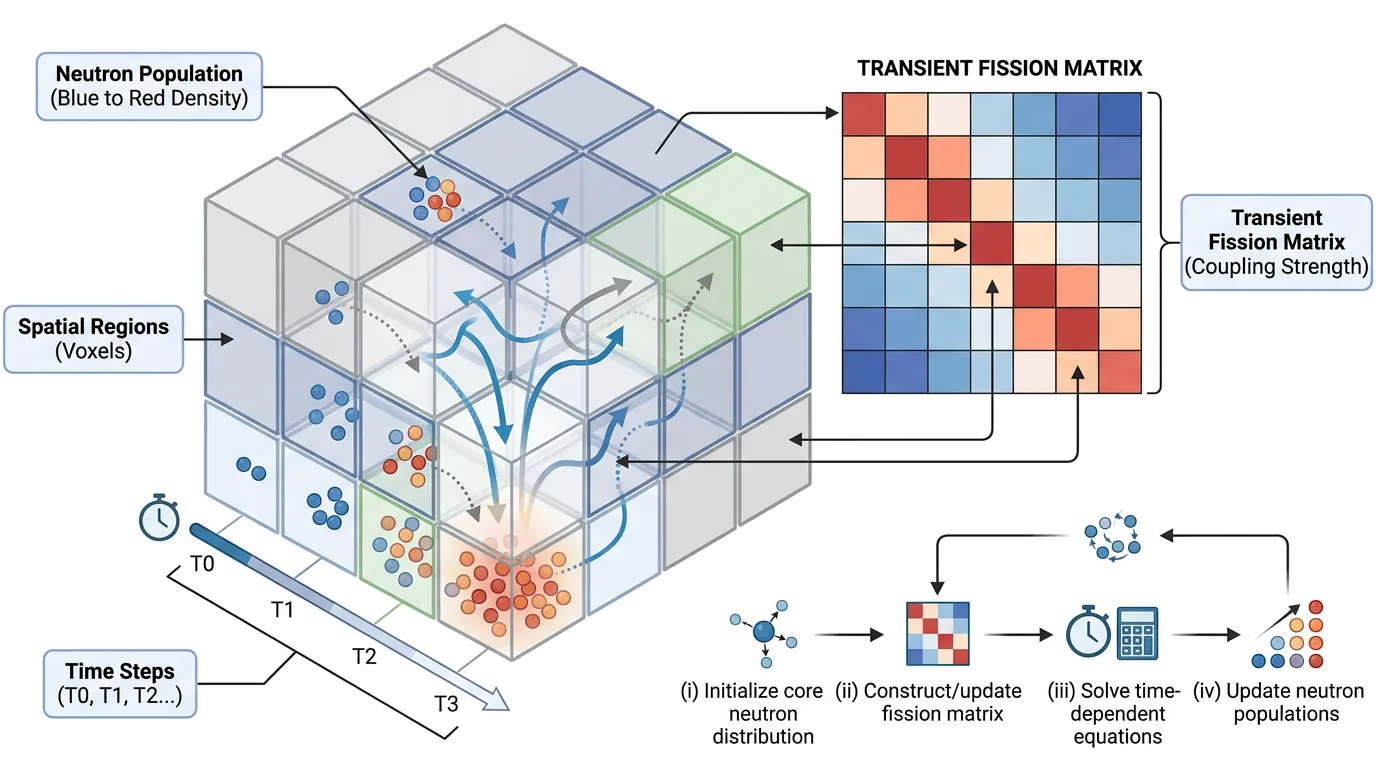
We are developing a novel framework for real-time high-fidelity neutron kinetics based on the hybrid transient fission matrix (TFM) methodology.
Hybrid particle transport enables the solution of the 3-D time-dependent neutron transport equation with Monte Carlo-level accuracy while reducing the computation time by 3 or more orders of magnitude.
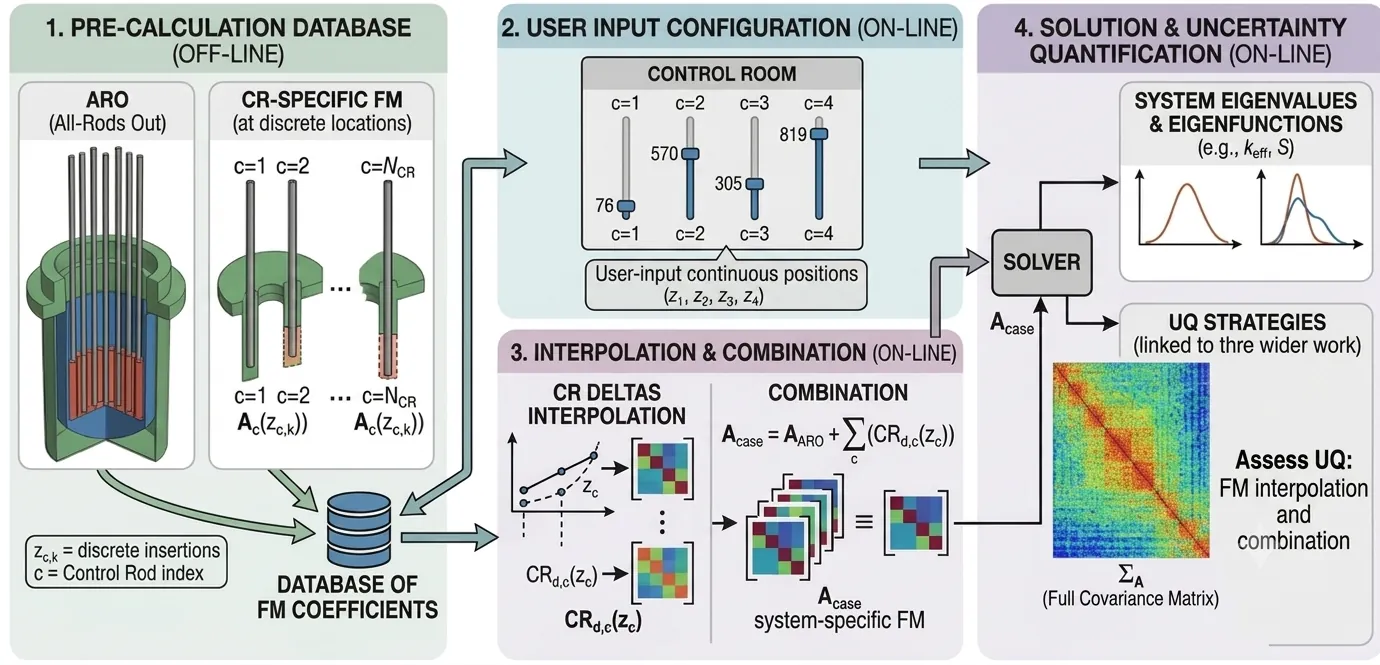
The framework is implemented in tfmines, a Python/C++ solver coupled to OpenMC that extracts fission-matrix tallies, solves for k-effective, the fission source and neutron importance, and runs slow and fast 3-D transients with control-rod motion. Recent work includes a rigorous framework for propagating Monte Carlo tally uncertainties through fission-matrix solutions, and a sensitivity study of the JSI TRIGA Mark-II rod-insertion transient to rod timing, rod speed profile and prompt neutron lifetime.
ML/AI-enabled simulators and digital twins
ML/AI-Enabled High-Fidelity Simulators and Digital Twins
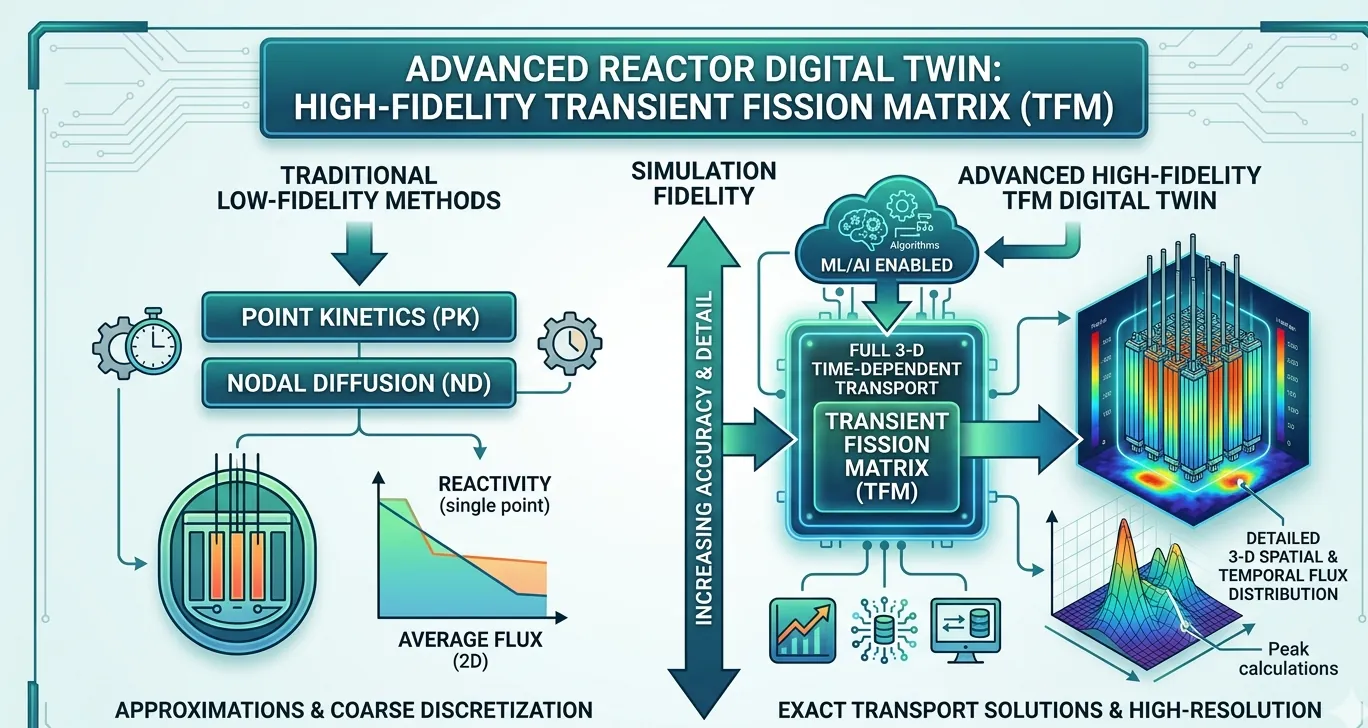
Digital twins built on full 3-D transport instead of point kinetics.
Artificial intelligence (AI) and machine learning (ML) applied to the TFM method can enable first-of-a-kind high-fidelity digital twins based on full 3-D time-dependent neutron transport, instead of lower-fidelity approaches (e.g., point kinetics and nodal diffusion).
ML/AI algorithms can be used for optimizing the generation of high-fidelity response functions, learning dependencies of the TFM coefficients, and accelerating the time-convolution of the fission source.
Current efforts include neural-network models of thermal feedback in the fission matrix, interpolation of fission-matrix coefficients across large temperature differences, and fission-matrix-based criticality search for heat-pipe microreactor design.
Validating GRACE: in-core flux from ex-core detectors
Neutronics Validation of ANL's GRACE – Green's-kernel Reconstruction from Accessible Ex-core Measurements
Seeing inside small reactor cores using only detectors placed outside them.
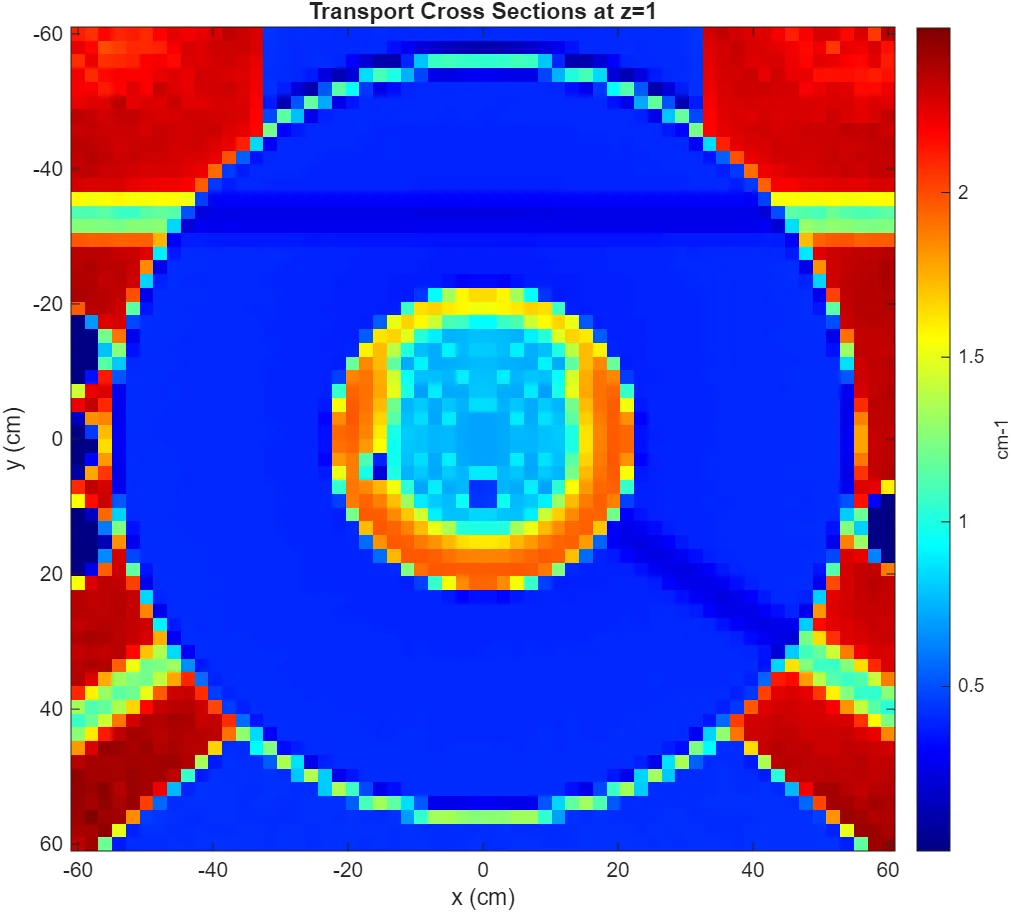
The placement of detectors and instrumentation within the core of small and micro modular reactors is a challenge given the very limited real estate within the core. Scientists at Argonne National Laboratory have developed a methodology using a machine-learned Green's function based on the neutron diffusion equation to achieve detailed in-core flux reconstruction using out-of-core detectors only. We are working with Argonne to validate their algorithm and evaluate the validity of the diffusion approximation.
Open-source research reactor design for proliferation resistance
Advanced Open-Source Research Reactor Design with OpenMC and ADDER for Proliferation Resistance Optimization
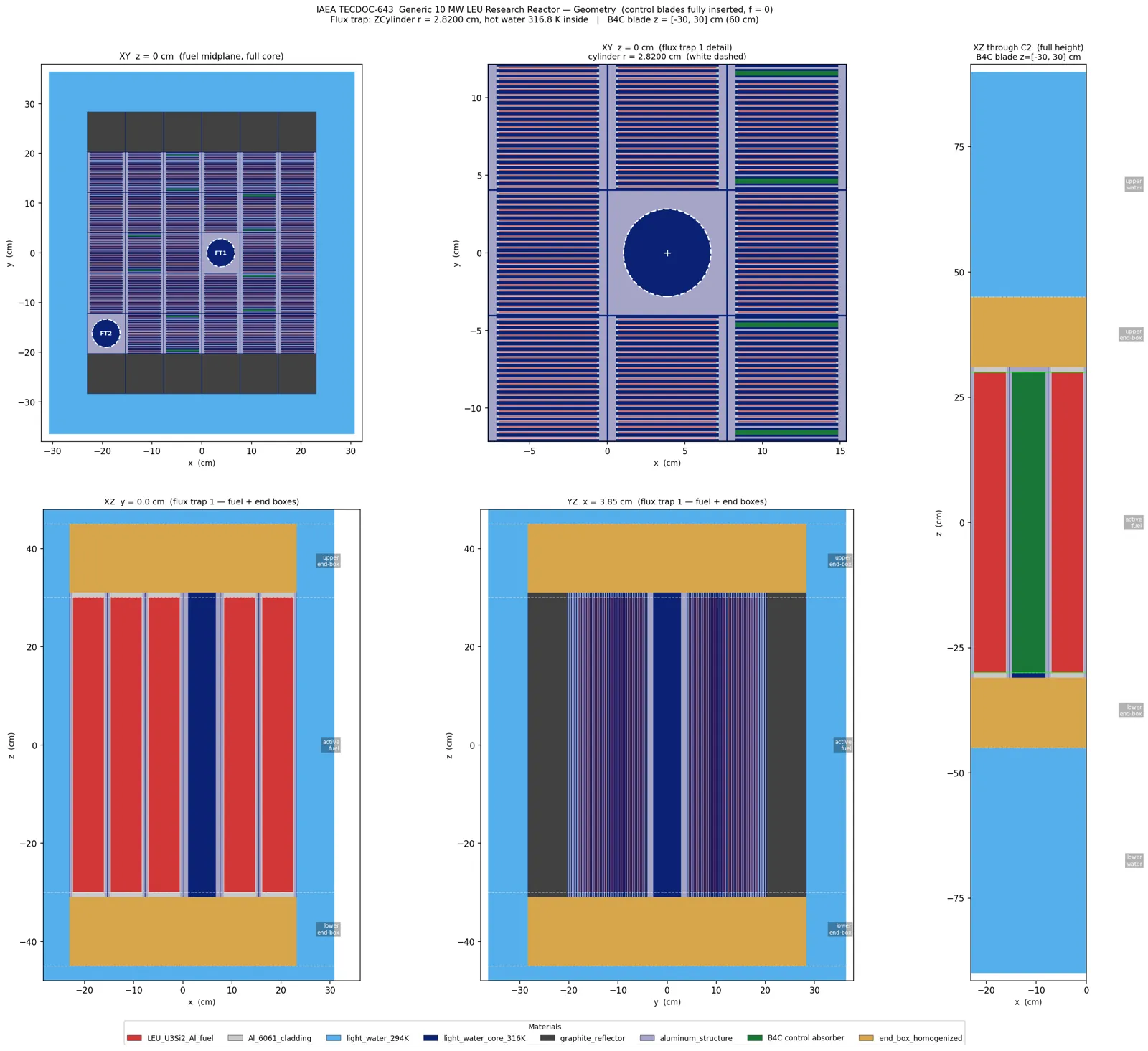
An open OpenMC benchmark of the IAEA-TECDOC-643 plate-type core.
Research reactors are an essential tool in support of the design, operation, and licensing of the next generation of advanced power reactors, as well as for the production of essential radioisotopes for industrial and biomedical applications, including diagnostics and therapy.
In collaboration with Argonne National Laboratory, we are developing a specification and modern model using the OpenMC software of the IAEA-TECDOC-643 core for plate-type reactors, which will serve as the main benchmark for the development of a fully open-source suite for operation-informed depletion and fuel management software based on OpenMC and ADDER. This work supports the DOE-NNSA's Proliferation Resistance Optimization (PRO-X) project.
OpenMC models of research reactors: JSI TRIGA Mark-II and MURR
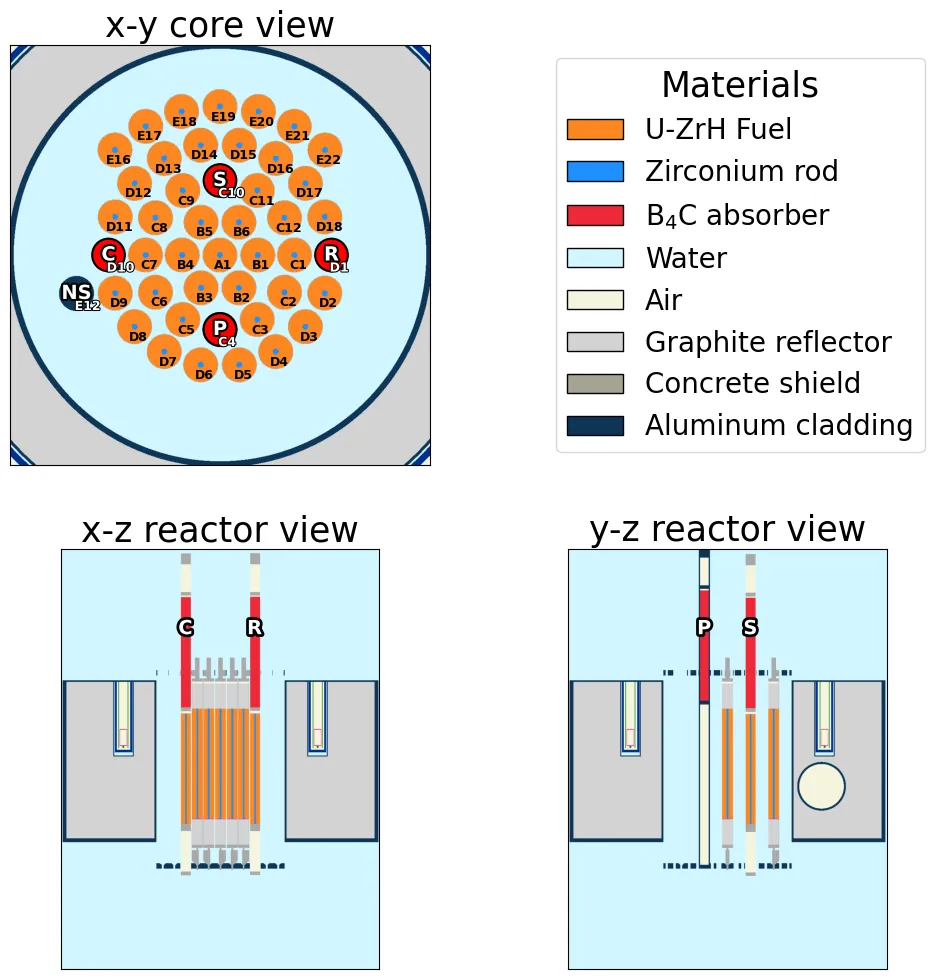
MURR model agrees with MCNP to within 50 pcm across six control-blade states.
We develop detailed OpenMC models of research reactors to support code verification, validation and fission-matrix methods development. The JSI TRIGA Mark-II models (cores 133 and 189), developed in collaboration with the Jožef Stefan Institute, include fuel, control rods, grid plates, the graphite reflector and irradiation channels.
The University of Missouri Research Reactor (MURR) model has been verified against MCNP 6.3.1 to within 50 pcm in k-effective across burned and fresh fuel and six control blade states, with control blade worths agreeing within 0.25%. Validation against measured critical blade heights, blade worths and flux distributions is the next step.
Multi-physics modeling of fission-product precipitates in UO₂ fuel
Multi-Physics Modeling of Fission-Product Metallic Precipitates in UO₂ Fuel
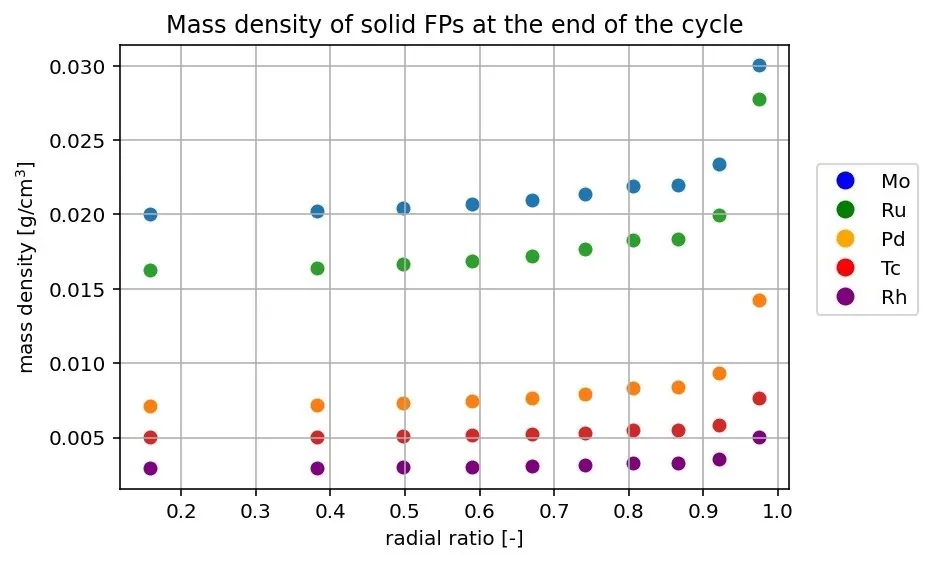
Linking reactor neutronics to how irradiated fuel changes at the microstructure scale.
In collaboration with Politecnico di Milano, we link reactor neutronics to fuel microstructure. OpenMC depletion models of an AP1000 fuel pellet and a 17×17 assembly provide burnup-dependent isotopic inventories, fission rates and temperature profiles that feed fuel-performance models of the formation and evolution of metallic fission-product precipitates in irradiated UO₂ fuel.
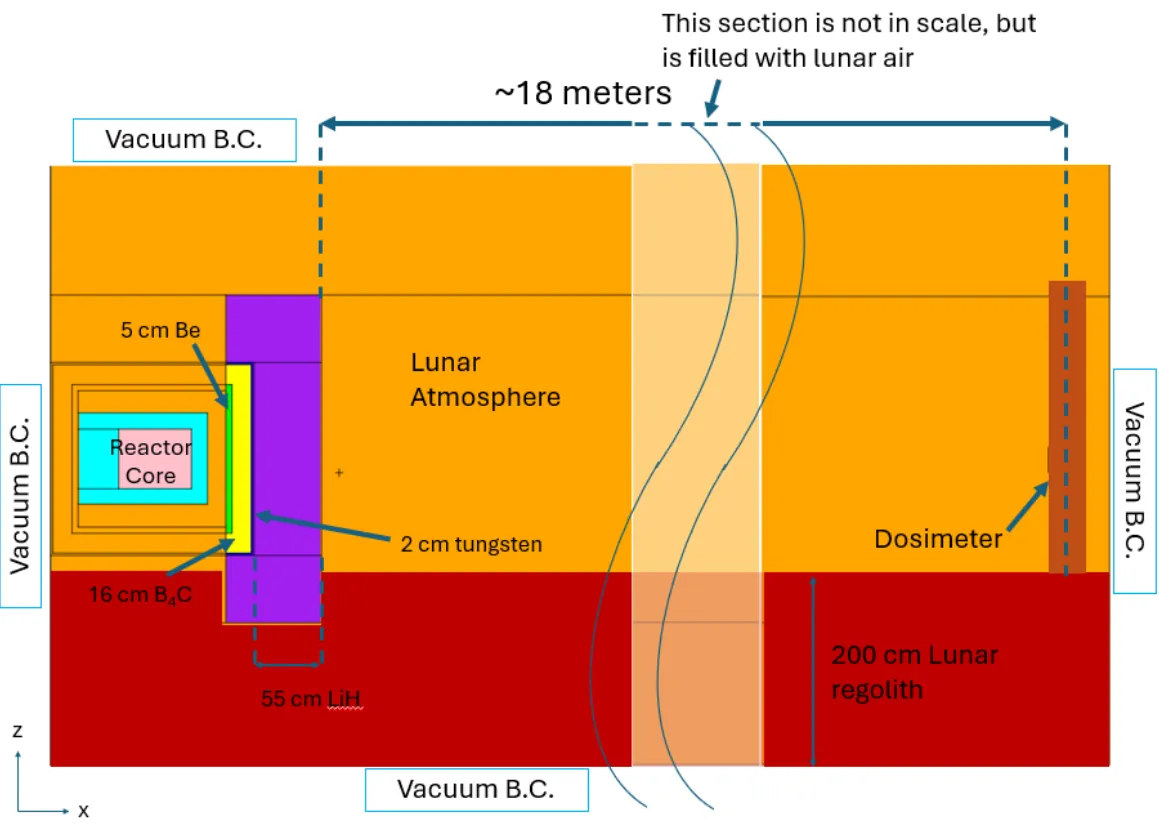
Lunar fission surface power: radiation shielding
Making dose calculations tractable for reactors on the Moon.
We develop methods for large-scale radiation shielding analysis of fission surface power reactors for lunar exploration, combining deterministic transport and variance-reduced Monte Carlo to make dose calculations tractable for realistic geometries.