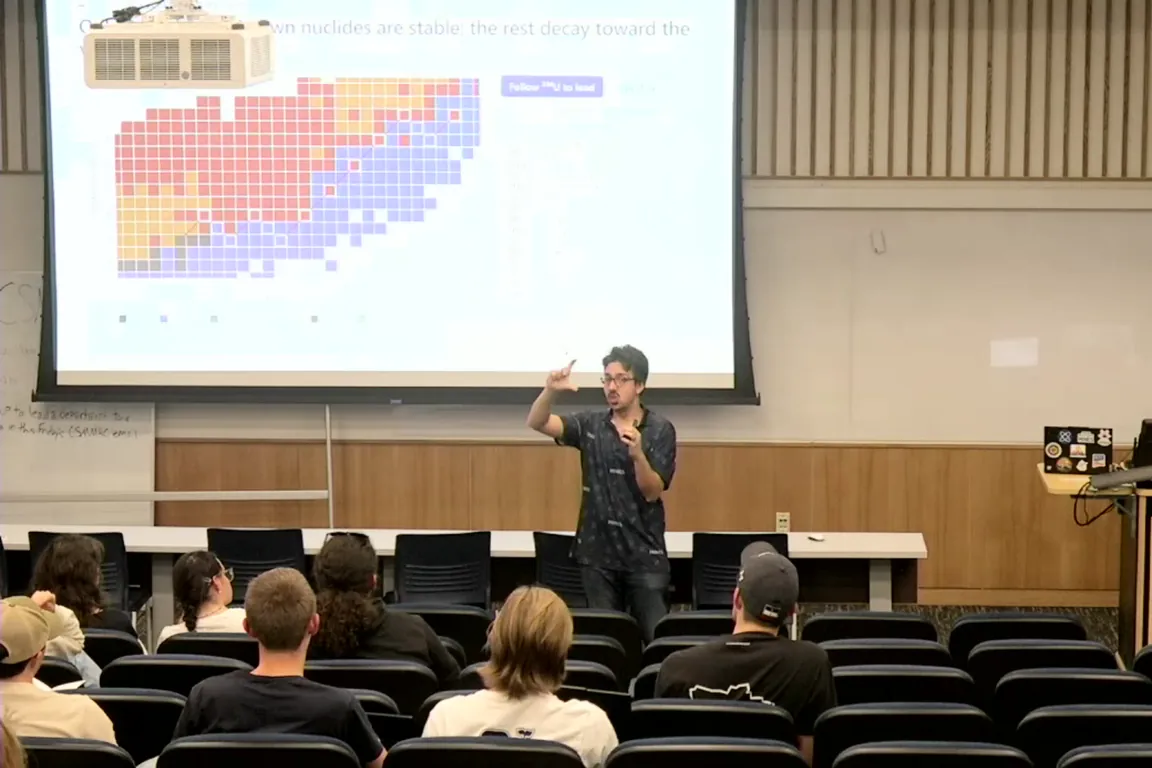
On Wednesday, 28 October, I gave Nuclear 101 for the Mines ANS Student Section, the campus section of the American Nuclear Society, where I am the faculty advisor. It took the slot of that week's Nuclear Science and Engineering seminar, in Hill Hall 202. The flyer asked for no background: if you know calculus and E = mc², you are ready.
The goal was a decoder for this year's seminars. Many speakers come to campus to present their advanced reactor designs, so I left the designs aside and taught the basics that make those talks easy to follow. The route had five stops: the nucleus and radioactivity, fission and criticality, power plants, enrichment and the fuel cycle, and advanced reactors. Questions came all the way through, so the hour ran long: we covered the first four stops in about 85 minutes, and open questions took another 20. The fifth stop is in the slides.
It opened with a vote. A headline says a new reactor “went critical”: what happened? Many hands showed the right answer, a steady chain reaction for the first time, but not all of them, which is why we were there. Critical means steady: each generation of neutrons replaces the last, at any power. Five new advanced reactors reached criticality in 2026, and reaching it is a physics experiment, still far from putting power on the grid.
The slides are a single web page that I built with Claude Code, and most of them are live: small simulations that run in the browser on real nuclear data. The binding-energy curve, and a slider that splits uranium into any pair of fragments, come from the IAEA mass tables. The chart of nuclides (in the figure) shows all 3,386 known nuclides, only 244 of them stable, and can follow uranium-238 through its 14 decays to lead. Cross sections come straight from the ENDF/B-VIII.0 library. Other slides roll 400 atoms of bismuth-214 to show the exponential decay law, and zoom from one fuel pellet to a core of about 14 million.
In the enrichment section, the critical mass of bare uranium metal comes from my own OpenMC runs, checked against the Godiva benchmark: about 53 kg at 93.7% uranium-235 and 786 kg at 20%. Below about 5.5%, no amount of bare metal goes critical. That wall is why 20% is the line between low-enriched and highly enriched uranium. In water, a few percent is enough, which is how power reactors run on 3 to 5%.
The recording, the slides, and the flyer are linked below. The slides are one HTML file: download it and open it in a web browser, and every demo runs offline, with nothing to install. Each slide cites its sources, listed in full at the end, next to a one-page decoder of sixteen terms you will hear at the seminars.
Watch the lecture (video, 1 h 25 min) (external site)
Download the interactive slides (HTML, 3.8 MB) (external site)