M-PRISM research
ML/AI-enabled simulators and digital twins
ML/AI-Enabled High-Fidelity Simulators and Digital Twins
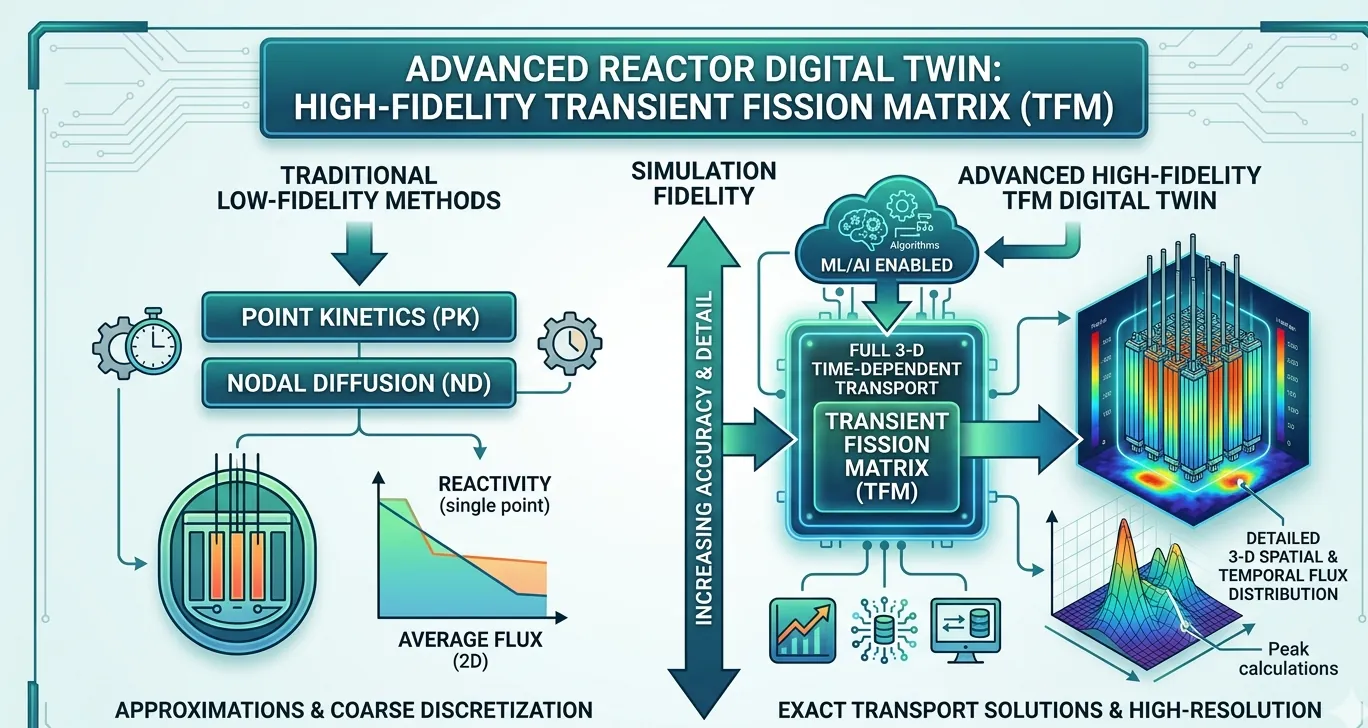
Digital twins built on full 3-D transport instead of point kinetics.
Machine learning (ML) and artificial intelligence (AI) applied to the TFM method can enable first-of-a-kind digital twins based on full 3-D time-dependent neutron transport, instead of point kinetics or nodal diffusion.
ML/AI can optimize how high-fidelity response functions are generated, learn how TFM coefficients depend on reactor conditions, and speed up the time-convolution of the fission source.
Current work includes neural-network models of thermal feedback in the fission matrix, interpolation of fission-matrix coefficients across large temperature differences, fission-matrix criticality search for heat-pipe microreactors, and compression of control-rod fission-matrix databases.