M-PRISM research

Validating GRACE: in-core flux from ex-core detectors

Neutronics Validation of ANL's GRACE – Green's-kernel Reconstruction from Accessible Ex-core Measurements

Across seven control-rod configurations, the JSI TRIGA's one-group cross sections change by at most 5.9% on average.

Small and micro modular reactors leave little room for in-core detectors. Argonne National Laboratory developed GRACE, which reconstructs the in-core flux from ex-core detectors with a machine-learned Green's function based on one-group neutron diffusion.

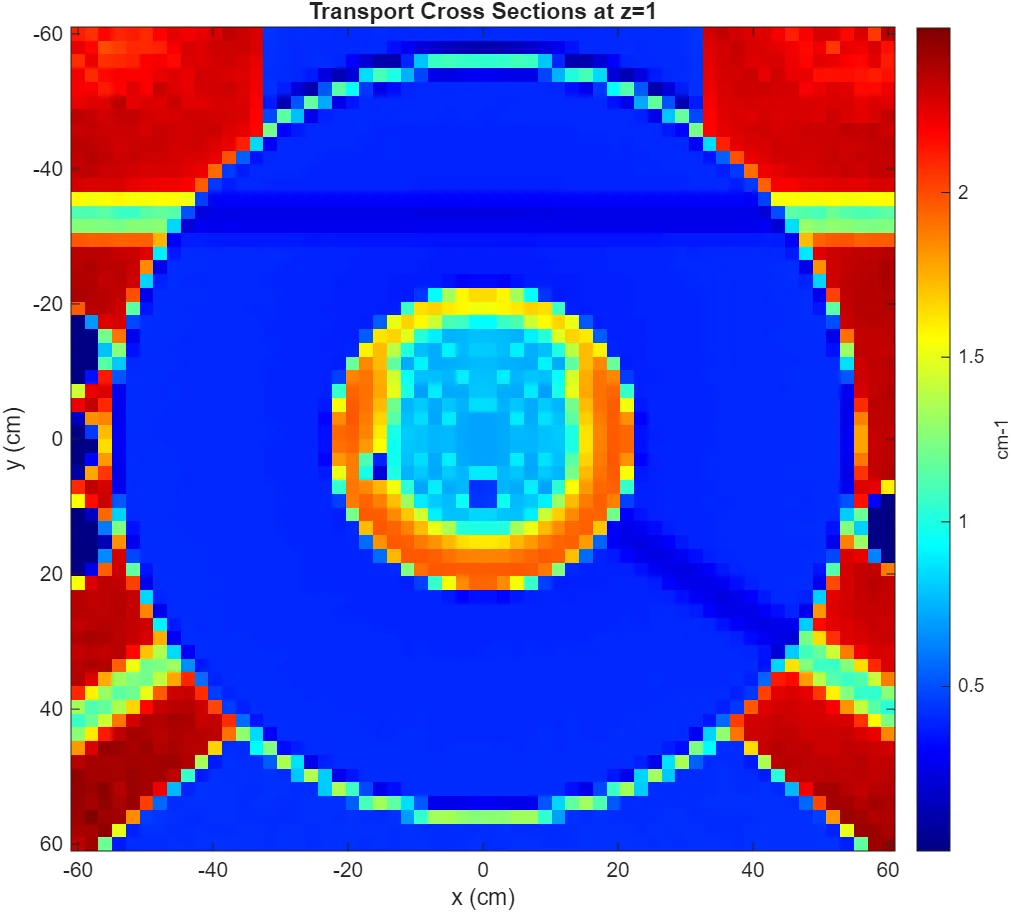
We are working with Argonne to validate GRACE and to test the diffusion approximation it relies on. With an OpenMC model of the JSI TRIGA Mark-II, we build effective one-group nuclear data and measure how control rods change them. Next, we test whether one reference Green's function holds across rod positions, burnup, and temperature.
  • Flux reconstruction
  • Validation
  • SMRs and microreactors
Map of transport cross sections at z = 1 for a research reactor model, in units of inverse centimeters.
Map of transport cross sections at z = 1 for a research reactor model, in units of inverse centimeters. Select to enlarge.

Papers

  • Nov 2026
    Conference paper Evaluation of the Effect of Control Rod Positioning on One-Group Effective Nuclear Data for Ex-Core Flux Reconstruction in the JSI TRIGA Mark-II Reactor

    J. LaFore, H. Wang, A. Pungerčič, R. Ponciroli, and V. Mascolino

    Transactions of the American Nuclear Society, Phoenix, AZ, USA

Related work by our partners

  • Apr 2026
    Conference paper Who Needs Big Data? Small-Data Flux Reconstruction via Green's Functions and Ex-Core Detectors

    R. Ponciroli, H. Wang, V. Theos, J. Lau, S. Chatzidakis, and R. B. Vilim

    Proceedings of the International Conference on the Physics of Reactors (PHYSOR 2026), Turin, Italy

People

Partners

Argonne National Laboratory · Jožef Stefan Institute

Work on this project

All research projects