M-PRISM research
Flux-trap design for the POLARIS research reactor
Flux-Trap Buffer Zone Design and Neutronics for the Virginia Research and Education Reactor (POLARIS)
A movable buffer zone tunes the neutron spectrum in the reactor's central irradiation cavity.
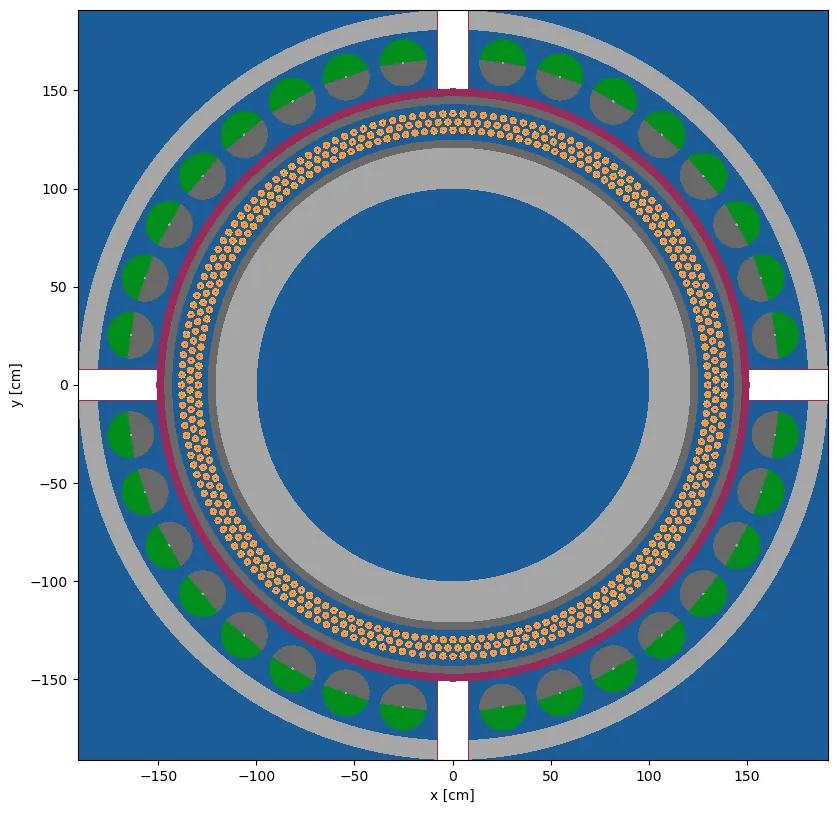
POLARIS, formerly the Virginia Research and Education Reactor (VA-RER), is a research reactor concept from Virginia Tech. A ring of HALEU TRIGA fuel surrounds a large central irradiation cavity. A buffer zone between core and cavity limits the cavity's reactivity feedback on the core and tailors the neutron spectrum for experiments.
Our first OpenMC study compared cavity radii from 6.25 to 100 cm and found diminishing reactivity gains beyond about 25 cm. We now design the buffer zone. One OpenMC run gives both the fission matrix and the detector responses in the flux trap, so many layer materials, thicknesses, and coolants can be compared quickly.