The 2026 ANS Winter Conference & Expo met in Phoenix, Arizona, from 15 to 18 November. It was a full week for the group: two talks on our JSI TRIGA Mark-II work, a module of the ANS Nuclear 101 course, and two technical sessions to chair.
The week started before the technical program. On Sunday and Monday, I taught Module 2, Nuclear Fundamentals, to one of the two classes of ANS Nuclear 101 (external site), the American Nuclear Society's five-day certificate course in nuclear science and technology. It was my first time teaching the course. Module 2 is the physics that the later modules build on. On Monday I also held office hours over lunch with Sunil Chirayath, another of the course's instructors.
On Wednesday morning, in the Reactor Physics Methods session, I presented Samah Balouza's paper. Samah was not at the meeting, so I gave the talk for her. The paper compares two ways to compute fission-matrix coefficients with OpenMC. On JSI TRIGA core 133, the criticality approach reproduced the reference k-eff within 1 pcm. The fixed-source approach, which assumes a uniform source inside each region, differed by about 510 pcm. The talk showed where that bias comes from.
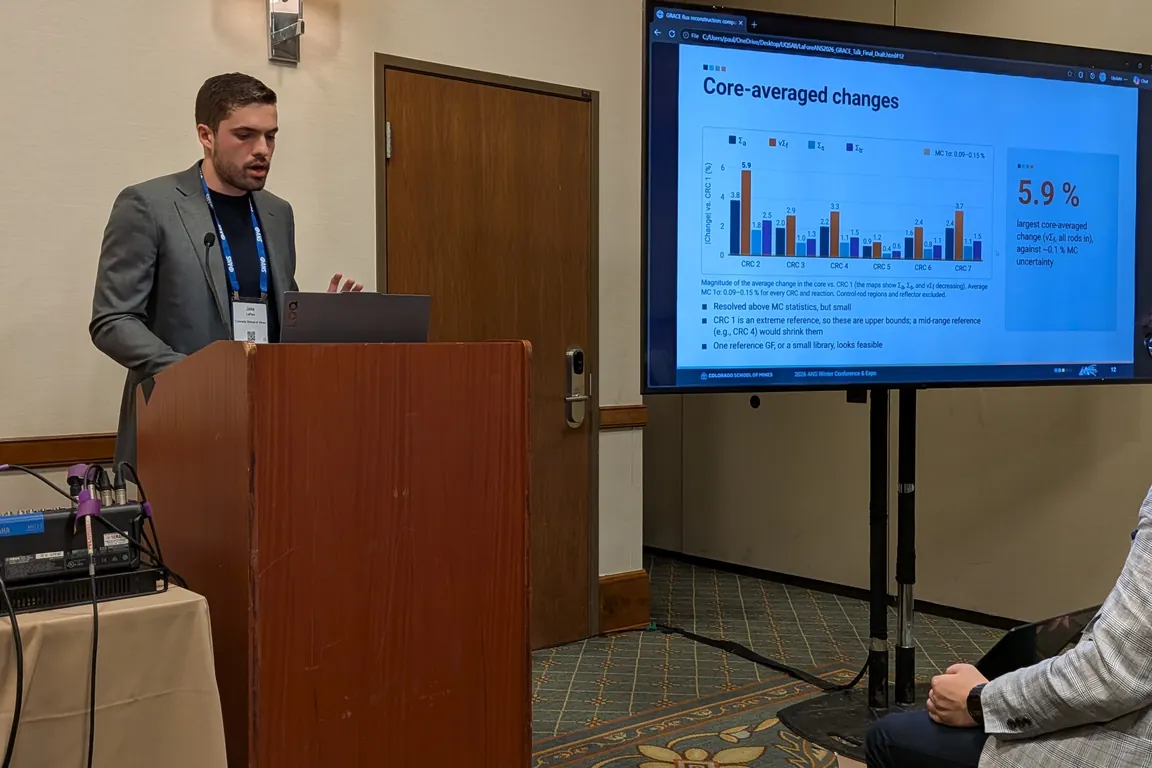
Two hours later, undergraduate Jake LaFore presented his own paper (in the figure), in the session on uncertainty quantification, sensitivity analysis, and machine learning. It supports GRACE, Argonne National Laboratory's method for reconstructing the neutron flux inside a core from detectors outside it. Across seven control-rod configurations, the effective one-group cross sections that GRACE needs changed by at most 5.9%, averaged over the core. So one reference Green's function, or a small library of them, may serve across rod positions. The talk came two months after Jake's Best Speaker award at the Undergraduate Physics Conference of Colorado.
Both talks tried a new format. Each one was an interactive web page instead of a slide deck, built with Claude, Anthropic's AI model, from our own data and results, and its calculations ran live in the room. In Samah's talk, a fission matrix fills up column by column, and the power iteration re-solves the eigenvalue and the source when a control rod goes in. In Jake's, a click moves a point source around the core, and the Green's function of the diffusion equation is solved live from his effective one-group data. Simplified models were labeled as illustrative; everything else came from our OpenMC results. Both talks are linked below. Each is a single file that opens in a web browser, with nothing to install.
I also chaired two technical sessions. On Tuesday, AI-Assisted Reactor Analysis (external site) had three talks from Texas A&M University on agentic AI for reactor design, predictive AI for design-space exploration, and how consistently large language models collect reactor data. On Wednesday afternoon, as its alternate chair, I ran Advanced Reactor Analysis: II (external site), with four talks from Oak Ridge National Laboratory, Purdue University, Georgia Tech, and Texas A&M University, from SEFOR and EBR-II to a thorium-fueled molten salt reactor.
Both papers appear in the Transactions of the American Nuclear Society, and an earlier news item describes them in more detail. The work continues with the Jožef Stefan Institute and Argonne, in the real-time neutron kinetics project and the GRACE validation project.
 Comparing Fission Matrix Approaches using a JSI TRIGA Mark-II Reactor ModelSamah Balouza
 Evaluation of the Effect of Control Rod Positioning on One-Group Effective Nuclear Data for Ex-Core Flux Reconstruction in the JSI TRIGA Mark-II ReactorJake LaFore
Jake's GRACE talk (interactive web page, 4.2 MB)
Samah's fission-matrix talk (interactive web page, 5.4 MB)